
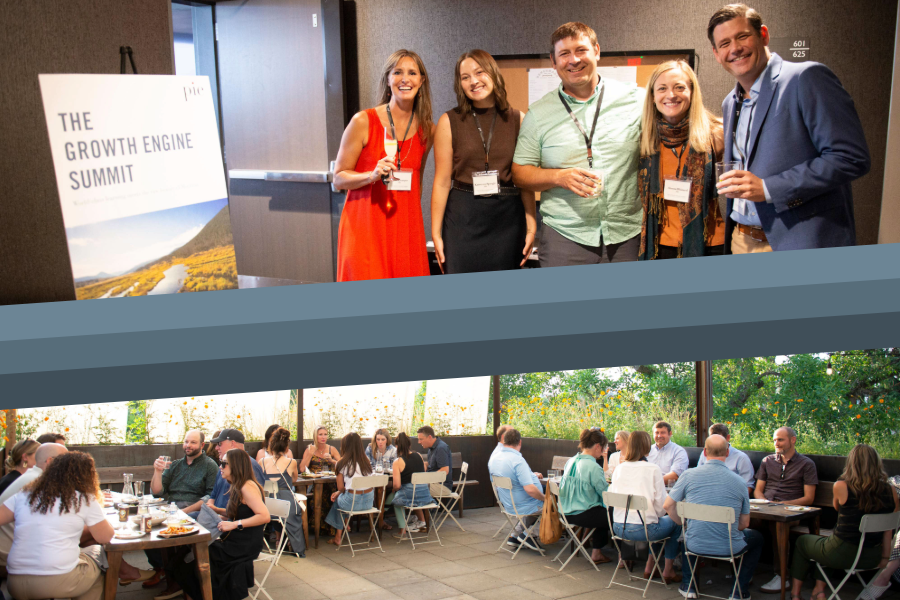
In our experience, when 30+ senior marketing, growth, and business development leaders touch down in Bozeman, Montana, the conversations tend to move quickly beyond small talk to big things, like social capital, aligning teams and resources around AI, and other key growth issues.
For two days this August, PIE welcomed executives from some of the world’s leading organizations across financial services, construction, cloud computing, and other industries for our second Growth Engine Summit.
Against a backdrop of mountain peaks, winding rivers, and wide-open skies, this accomplished group of leaders came together with their peers to strategize around the forces shaping growth, strengthen their perspectives on client relationships, and examine the evolving role of marketing and business development within their organizations.
As one attendee put it, “The sessions, the candid, practical conversations, and the caliber of leaders in the room provided an amazing opportunity to learn from one another. There’s something powerful about stepping away from the day-to-day and spending time with peers who truly understand the unique role growth and marketing leaders play within their organizations.”
Day one opened with Seth Rachlin, co-author of the upcoming book Social Capital at Work, leading a discussion on the growing importance of social capital in professional services. Rachlin noted that social capital now sits alongside human and economic capital in determining which organizations, projects, and ideas succeed.
The discussion gained momentum during a client panel exploring how PIE’s Executive Communities help organizations identify growth opportunities, build competitive moats, surface content themes, and move their client relationships from transactional to trusted partnerships.
At the heart of these communities is a simple but powerful strategy: help firms build meaningful relationships with the prospects they most want to serve, while becoming the trusted, go-to partner for industry-leading conversations.
As the day continued, attendees tackled topics ranging from account planning to mastering client feedback and fueling growth with AI. Conversations centered on how AI is reshaping business development, changing approaches to account planning, increasing content visibility, and creating new opportunities for customer acquisition.
Explore Takeaways from Day 1 of the Growth Engine Summit.
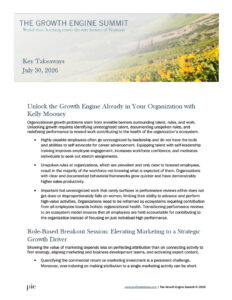
While day one focused on new perspectives, day two centered on organizational transformation.
Kelly Mooney, author of the forthcoming book UP!, got things started by encouraging attendees to consider the invisible barriers surrounding talent, organizational expectations, and performance structures. Her remarks sparked a series of discussions about how firms can better identify unrecognized talent, document unspoken rules, and redefine performance to reward work contributing to the health of the organization’s ecosystem.
Throughout the day, conversations repeatedly returned to a common theme: alignment. Attendees shared how integrating marketing and business development functions through stronger CRM governance, shared accountability, and well-defined processes can help make marketing less reactive and more directly connected to growth outcomes.
In one particularly engaging session, attendees discussed the importance and challenge of developing impactful client feedback programs. Attendees agreed that if done effectively, client feedback programs can drive enormous value for organizations and simultaneously forge stronger relationships with clients.
PIE helps clients capture real-time feedback, identify growth opportunities, align business operations with customers through Clients and Market Insights Reports and Client Advisory Boards.
The Summit concluded with one final roundtable discussion focused on AI’s growing influence on service delivery, talent development, and client engagement. Leaders shared how they are adapting contracts to include client-friendly language about AI to help close deals faster. Others noted the need to train junior staff to critically evaluate and refine AI-generated outputs to maintain operational efficiency and quality in their day-to-day work.
Review Insights from Day 2 of the Growth Engine Summit.
While the Summit was focused on expanding insights into the latest challenges facing growth and marketing leaders, attendees also had the chance to step away and experience all that Montana has to offer. From whitewater rafting and hiking to golfing and exploring historic downtown Bozeman, attendees were able to connect and continue a dialogue well beyond the conference room.
When it was all said and done, the Summit offered new ideas, fresh perspectives, and stronger connections to peers facing many of the same challenges and opportunities.
We look forward to welcoming the next cohort of growth, marketing, and business development leaders back to Montana for our third Growth Engine Summit.